
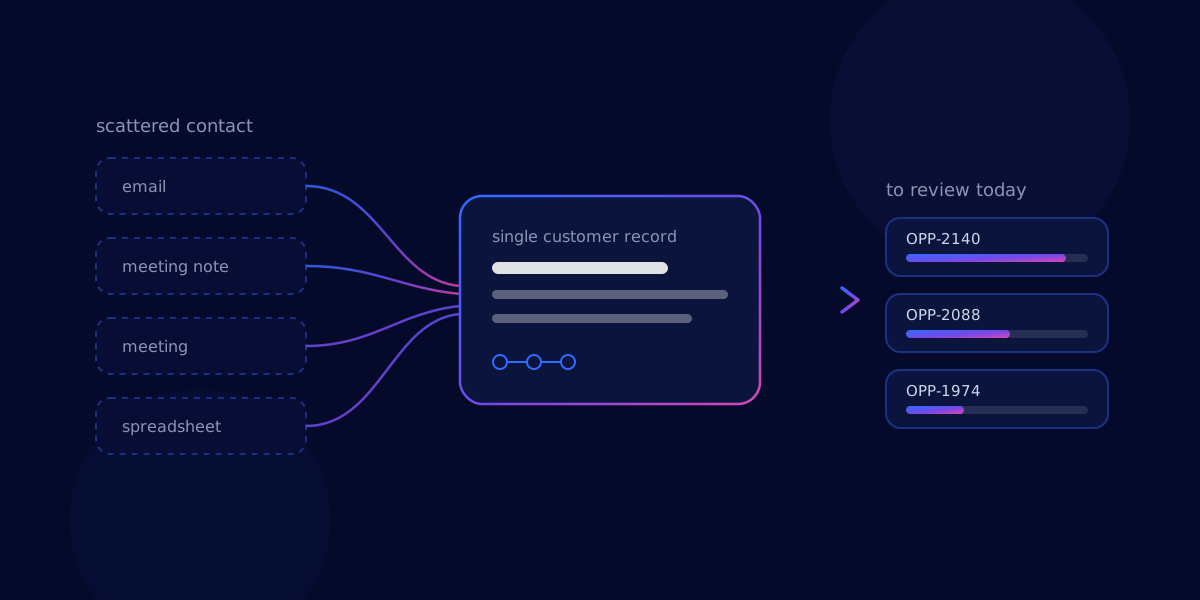
A sales rep's day is rarely spent at a desk. A call in the morning, two visits in the afternoon, and questions arriving by email and messaging apps in between. By the end of the day, what's left is several separate pieces of context, none of which have been entered into the system yet.
The CRM AI conversation usually starts at the wrong end: scoring, forecasting, automatic reports. Yet all of these use the same incomplete record as their input. Below we follow the flow from a conversation to a record and from a record to a forecast, and at each stop we look at what breaks and where exactly AI breaks the chain.
Why don't sales teams update the CRM?
Logging a visit means opening the app, finding the right account, going to the activity form and filling in required fields one after another, often from a phone screen in a parking lot. When a rep puts this off, they aren't being undisciplined; they've worked out how many stops a day they'd have to repeat it for.
The second reason is more structural: the person entering the record isn't the person who benefits from it. The rep fills it in, and the table gets opened in the manager's meeting. If the information going into the system doesn't give the rep anything back, such as the next step, a pending follow-up or a risk, the record feels like extra work rather than a gain.
The third runs against most managers' intuition. With every new reporting need, a required field is added "for visibility"; as the form grows longer, the care taken in filling it drops and optional fields are mostly left empty. Adding requirements doesn't raise data quality; it often leads to fields being filled in just to dismiss the warning.
Why can't you trust a forecast built on missing data?
A CRM is a record not of what happened, but of what someone found time to write down. When the report runs on that record, what you see isn't today's opportunity, but its state on the last day someone found time to write. The forecast inherits the same delay.
Gaps become invisible as they turn into numbers. If stage exit criteria aren't defined, a "proposal sent" record that hasn't moved in weeks is added up with the same weight as a live opportunity and makes the pipeline look stronger than it is. A close date that is quietly pushed forward is the clearest sign of slippage; when the reason isn't noted, it shows up in the report only as a date change.
Incentive-driven distortions add to this: some reps understate their pipeline to protect their number, others hear what they want to hear and commit. These aren't data problems but incentive problems. The real issue is that when a record is left incomplete today, the loss doesn't stay there; a few months later the same gap settles into the pattern the model learns, and after a while the system stops producing reports and starts producing confident opinions.
How do meeting notes, emails and meetings become records?
What people usually expect from sales automation is reporting; but its real job is producing the record itself. The calendar invite, the email thread and the meeting notes are content that already exists. AI's contribution here is turning that content into structured fields, in other words not asking the rep to write the same information a second time.
In solutions like CRM-X, decisions, objections and the next date are extracted from the free-text note written after a meeting, and fields are filled in with the user's approval. This also gives you the yardstick: if a tool enriches the record but doesn't shorten the time the rep spends writing, the problem it solves is reporting, not data entry.
This layer isn't as precise as people assume. Automatic activity matching relies mainly on email addresses; shared inboxes, contacts writing from personal addresses or prospects not yet in the system systematically end up in the wrong place. On the audio side, noise, accents and overlapping speech produce errors; the most insidious error, though, is omission, because when a one-sentence condition like "legal approval is needed first" drops out of the summary, the text looks flawless and nobody goes back to check.
The right setup treats the summary as a draft, not as evidence. Being able to link every extracted point back to its place in the conversation transcript is the only real verification method. Write permissions should also be tiered: low-risk fields can be filled in automatically, while fields such as price and commitments should go through human approval. Regularly measuring the share of unmatched activities is also part of maintaining this layer.
Which opportunity should you look at today?
The question in the field isn't "what's the overall state of the pipeline?" but "which three opportunities should I look at today?" Opportunity scoring answers exactly that: a ranking learned from records that were won and lost in the past. For it to work, you need enough closed records and, just as importantly, the loss reason actually has to be written down; if the number of closed deals is small, the score produces noise, not information.
Scoring has two known weak spots. The opportunity with a high score gets more attention, that opportunity closes, and the model is considered right; in fact it predicted the rep's behavior, not the buyer's intent. Second, when the product, pricing or target segment changes, the learned relationship breaks down. That's why the score should be used as a priority order, not a gate, and its re-evaluation should be put on the calendar.
For recommendations, the yardstick is even simpler: a recommendation without visible reasoning won't be adopted. "Call the customer" isn't a recommendation; "the proposal has had no reply for nine days and the decision-maker hasn't joined any meeting" is reasoning the rep can compare with what they know. Since telling forty opportunities the same thing on the same day isn't actionable either, capacity has to be part of the recommendation.
What does a single record give you when customer data is scattered?
In most organizations, information about the same customer doesn't sit in one place: it lives in an inbox, a personal spreadsheet, a messaging app and the ERP all at once. When the official system creates friction, reps build their own, and the spreadsheet wins not on features but because it opens in two seconds. That's why the idea of a single record matters: as long as customer, opportunity and activity aren't in the same place, reps keep their own copies and the official system falls a little further behind every day.
A single record is a matter of identity, not compilation. The healthy method is layered: first match on definitive keys such as tax number, domain name or normalized phone number, then use a similarity score for the rest. Turkish data has its own pitfalls too: the dotted and dotless i in case conversion, letters such as ğ, ş and ü when normalizing, and variant spellings of the company suffix "A.Ş." all make matching harder.
The risk of a merge decision isn't symmetrical. A missed duplicate can be fixed later; a wrong merge, however, mixes up two different customers' histories, contracts and communication consent, and in most systems it can't be undone. So the automatic merge band should be kept narrow, suspicious pairs should be put to a human, and every merge should remain traceable.
What should you watch for in terms of KVKK and auditability?
Automatic activity capture is where the scope grows fastest. An unfiltered mailbox sync also brings in private correspondence and third parties' data, and at the same time turns into an employee monitoring application. The concrete form of data minimization here is tiered modes: an allowed domain list, outgoing correspondence only, or metadata only instead of content. For many sales metrics, knowing who spoke to whom and when is already enough.
Call recording and summarization is the topic that needs the most care. Notice must be given before recording starts, and there must be a flow that can proceed without recording if the other party doesn't agree. The summary is also new personal data derived from the recording; when a correction or deletion request comes in, the audio, the transcript, the summary, the fields filled from them and the search index must all be handled together. Adding this flow later is expensive both technically and legally; for most past recordings it's no longer possible to prove that notice was given.
Auditability can be reduced to a single question: where did this field come from? It should be visible which recommendation was based on which record, who changed which field and when, and what the score was based on. In decisions with consequences for a person, human oversight shouldn't be a formality; and because each model and transcription provider may create a separate cross-border transfer, the chain of sub-processors should be clarified from the start. Role-based permissions and a timestamped change history should sit underneath the AI layer, not beside it.
Key takeaways
- The CRM doesn't stay current because the person entering the record isn't the person who benefits from it; adoption comes from the value the system gives back, not from instructions.
- Adding required fields doesn't raise data quality; as the form grows, records get filled in to dismiss the warning, not to produce a signal.
- Reports and forecasts show what someone found time to write, not what happened; stage clutter and pushed close dates turn that gap into numbers.
- AI's real contribution in sales isn't producing reports but turning meeting notes, emails and meetings into records without data entry; even so, a summary is a draft, not evidence.
- An opportunity score is a priority order, not a gate; if loss reasons aren't written down the loop doesn't close, and recommendations without visible reasoning aren't adopted in the field.
- A single record is a matter of identity, and a wrong merge costs more than a missed duplicate; in automatic capture, minimization, permissions and audit logging must be designed in from the start.
Frequently asked questions
What is the difference between an AI-powered CRM and a classic CRM?
A classic CRM is a system of record: you enter what happened, it stores it. In an AI-powered approach the difference shows up in two places. The first is how the record is created; because meeting notes, emails and meetings are turned into structured fields, the entry burden is lifted from the rep. The second is the direction of the output: the system doesn't just show a table, it flags pending follow-ups and cooling opportunities with its reasoning. The difference isn't in the feature list, but in who is left doing the record-keeping.
How do I get my sales team to adopt the CRM if they don't use it?
Pressure alone doesn't create adoption; as the form grows longer, records become a formality. The lasting solution is for the system to give something back to the people entering data: a daily priority list, follow-up reminders, meeting history that's ready when needed. Cutting required fields down to the few that really drive decisions, and generating most of the record automatically, gets results faster in most teams than increasing follow-up pressure.
How reliable is an AI-generated sales forecast?
The accuracy of the forecast depends less on the model than on how fresh and complete the underlying data is. If activities are entered days later, if there are no clear criteria for moving between stages or if loss reasons aren't written down, the result describes the past, not today. When the product, pricing or target customer profile changes, the relationship learned from the past also breaks down; that's why the forecast should be re-evaluated periodically.
When does tracking customers in Excel stop being enough?
For a process run by one person with a small number of opportunities, a spreadsheet does the job. The problem starts when the team grows: the same company is opened in more than one file, follow-up depends on someone's memory, and when a person leaves, the history leaves with them. If you have to ask who has the latest information about a customer, it's time to switch.
Does processing call recordings with AI create a KVKK issue?
It's possible when set up correctly, but a few points must be resolved from the start. Notice must be given before recording begins, and there must be a flow that can continue without recording for a contact who doesn't want it. The transcript and summary produced from the recording are also personal data; deletion and correction requests must cover the audio, the transcript, the summary and the search index together. Because model and transcription services may involve cross-border transfers, the sub-processor chain and retention periods should be clarified in the contract.