
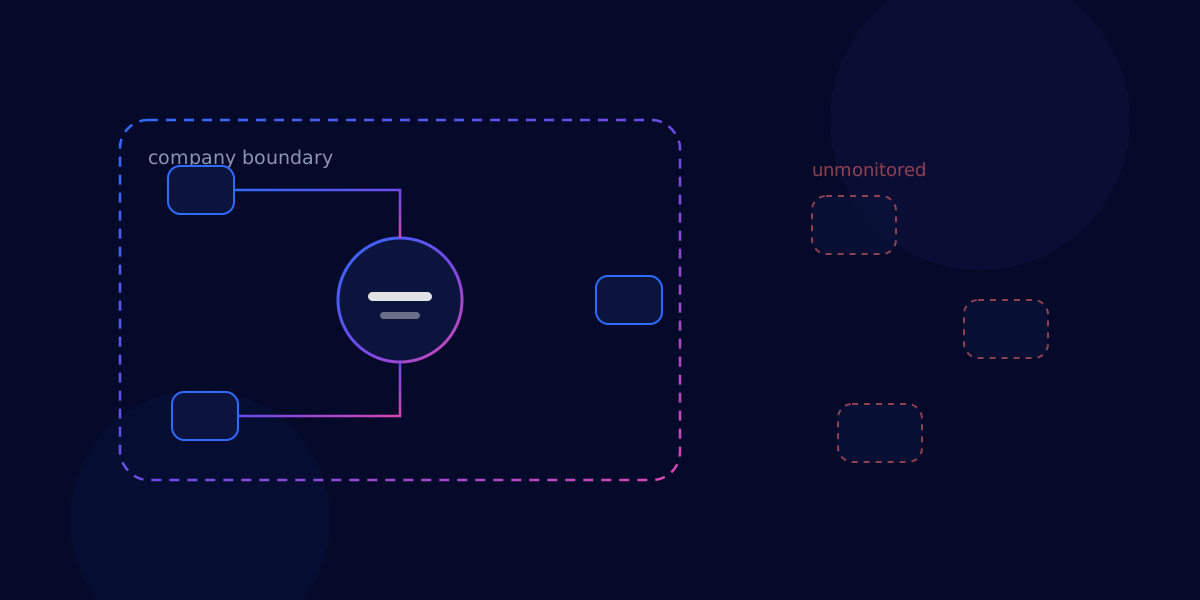
One evening, one of your employees pastes a contract into an AI tool they've logged into with a personal account, just to get a summary. They finish the job quickly, ask nobody, and nobody finds out. This behavior, which could technically count as a policy violation, is repeated many times a day in most organizations.
This is what's called shadow AI: AI tools used outside the organization's knowledge, approval and oversight. Shadow AI isn't really a discipline problem; it's a symptom of an unmet need. In this post we look at why it appears, what risks it creates, and how it can be made manageable instead of banned.
What is shadow AI, and how does it start in organizations?
Shadow AI covers any use of AI that isn't in the IT inventory, isn't tied to a corporate contract and doesn't pass through any oversight flow. Chat tools opened with personal subscriptions, browser extensions, phone apps and small automations a team has built on its own all fall under this heading. What they have in common: the organization doesn't know the interaction took place.
It almost always starts innocently, with small tasks like summarizing meeting notes, translating an email into English or asking about a spreadsheet formula. Because these tasks don't seem harmful to anyone, nobody thinks of asking permission.
The real drift comes once the habit has set in. After a while, customer lists, price quotes, snippets of source code or personnel information get pasted into the same tool. Nobody notices where the line was crossed, because there's no structure that draws and watches that line.
Why do employees turn to personal accounts?
The most common reason is that there's no corporate alternative at all, or that it's hard to access. When a request form, an approval chain and a procurement process stretch over weeks, the employee opens their own account rather than let a deadline slip. The choice here isn't defiance; it's speed.
The second reason is subtler: there is an internal tool, but it doesn't help. An assistant that can't access company documents, doesn't know the company's own terminology and produces generic answers won't convince anyone. People use the tool that genuinely helps them, not the one that's official.
The third reason is the ban itself. A strict ban doesn't remove the demand; it only moves the usage from the company device to a personal phone. At that point the organization loses both the risk and its visibility at the same time.
The four core risks of shadow AI
The first is data leakage. Data entered into a personal account is subject not to the corporate terms the organization negotiated, but to the individual terms of use the employee accepted alone. Where the data is stored, how long it's kept and how it's processed move out of the organization's control; when personal data is involved, the matter turns directly into a regulatory compliance issue.
The second is the lack of auditability. Which question was asked, which document was uploaded and which model answered are recorded nowhere. When an error is discovered later or an internal review begins, there's no trail to look back at.
The third is inconsistent answers, and the fourth is scattered cost. Two departments get two different answers to the same policy question, and over time those answers seep into official documents, proposals and customer correspondence. On the cost side, dozens of small individual subscriptions are spread across expense lines: the total spend is unknown and the benefit gained is never measured.
Why a ban isn't the answer
A ban removes visibility, not the need. Usage continues, but now on devices and accounts the organization can't see; the risk doesn't shrink, it just becomes unmeasurable. From an oversight perspective, that's the worst-case scenario.
A ban also has a competitive cost. Slowing down a team that has found a way to finish its work faster may look like compliance in the short term, but in the long run it drags down both productivity and employee satisfaction.
So the right question isn't "should AI be used?" The right question is: with which data, with which permissions, through which model and with what record? As soon as these four points are clear, the topic stops being a security debate and becomes a management matter.
The enterprise AI layer that makes shadow AI manageable
The essence of the solution is to set up a single front door. Employees ask their questions through one corporate interface; which model runs behind it, which data is accessed and how the request is recorded are decided by the organization. The user experience gets simpler, while the organization gains visibility.
For this layer to be convincing, answers have to be grounded in the organization's own knowledge. When the assistant answers by looking at procedures, contract templates, product documentation and internal policies, the appeal of going to an outside general-purpose tool fades on its own. Enterprise AI platforms such as HubAI-X aim at exactly this point: employees ask, assistants answer from company documents, and every request is governed from a single screen.
The answer to each of the four risks takes concrete form in this layer. Role-based access control (RBAC) limits who can access which data, model routing ensures consistent answers, budget control brings spending into one place, and the audit log creates a trail you can look back on.
Where to start: bringing shadow AI into the light
The first step is an inventory, and that inventory shouldn't be punitive. A short internal survey, an open conversation between managers and their teams, and a review of existing subscription expenses usually reveal most of the picture. The goal isn't to find who broke the rules, but to see which tasks need AI.
The second step is a readable data policy. Explain on a single page, in plain sentences, which class of data can be processed in which environment; a long guideline that nobody reads to the end has, in practice, the same effect as a policy that was never written.
The third step is to make the alternative genuinely useful and to measure the results. A single-screen platform, which is how HubAI-X is designed, produces the inventory on its own: who asked what, which assistant answered and where the cost is going all become visible in one place. Shadow AI is solved not by banning it, but by bringing it into the light.
Key takeaways
- Shadow AI isn't a discipline problem but a sign of an unmet need; employees turn to personal accounts because the corporate alternative is slow or inadequate.
- There are four core risks: data leakage, no audit trail, inconsistent answers across departments, and scattered, unmeasurable cost.
- A ban removes visibility, not demand; usage moves from the company device to a personal phone and the risk becomes unmeasurable.
- Manageability rests on three components: a single front door, role-based access control and an audit record for every request.
- The first step is a non-punitive inventory; the second is making the corporate alternative more useful than a personal account.
Frequently asked questions
What is shadow AI?
Shadow AI refers to AI tools employees use outside the organization's knowledge, approval and oversight. Chat tools opened with personal subscriptions, browser extensions and small automations teams build on their own all fall into this category. What they have in common is that they aren't in the IT inventory and leave no record.
Is banning shadow AI entirely the right strategy?
A ban usually doesn't deliver the expected result because it doesn't remove the need; usage simply shifts to personal devices the organization can't see. The risk doesn't shrink, it just becomes unmeasurable. A more effective approach is to move usage into an auditable enterprise layer and clearly define which data can be processed where.
How can shadow AI use be detected in an organization?
Network and proxy logs, authentication logs and individual subscriptions in expense items give the first clues. A browser extension inventory and open conversations with team managers can be added to these. Running the detection process to understand needs rather than to punish produces a much more accurate picture.
How does an enterprise AI platform reduce shadow AI?
By offering employees a single front door, it removes the need to go to outside tools. Because answers are grounded in the organization's own documents, the results are more accurate than those of general-purpose tools. With role-based access control, model routing, budget control and audit logging running behind the scenes, usage becomes both unrestricted and traceable at the same time.